

● Key Economic Indicators of Taiwan (Data released before Aug. 10, 2025
 GDP Economic Growth Rate (yoy) 3.10 (%) 2025 forecast |
 CPI Change Rate 1.37 (yoy, %) Jun. 2025 |
 Unemployment Rate 3.36 (%) Jun. 2025 |
 Monthly Regular Earnings of All Employees (Industry and Services) 47,796 (NT dollars) May. 2025 |
- The number of employed persons in June was 11.617 million, an increase of 6,000 (0.05%) compared to the previous month. The average number of employed persons in the first half of the year was 11.613 million, an increase of 32,000 or 0.28% compared to the same period last year. The number of unemployed persons in June was 404,000, an increase of 8,000 or 2.00% from the previous month. The average number of unemployed persons in the first half of the year was 400,000, a decrease of 3,000 or 0.76% compared to the same period last year.
- In May, the average regular earnings of all employed persons (including both full-time and part-time employees of domestic and foreign nationality) was NT$47,796, reflecting a monthly increase of 0.08% and an annual increase of 2.88%. Irregular earnings such as bonuses and overtime pay averaged NT$14,106, bringing the total average monthly earnings to NT$61,902, a monthly increase of 11.56% and an annual increase of 7.20%. The medium regular earnings stood at NT$38,224, representing a monthly increase of 0.22% and an annual increase of 2.59%.
Source: National Statistics, Republic of China (Taiwan)
● Statistics on Republic of China Nationals Traveling Abroad
| Outbound departures of nations in January – May 2025 7,492,590 |
| Year on Year +11.8% |
| Outbound departures of nations in May 2025 1,525,029 |
| Month on Month +3.4% |
114年4月及1至4月中華民國國民出國人次及成長率-按目的地分


★Source: Ministry of the Interior, Immigration Office (Republic of China)
Note: The outbound travel data for Republic of China nationals is based on the principle of counting the first destination reached by flight. Additionally, factors such as irregular chartered flight itineraries are included. Therefore, for the actual data on Taiwanese nationals traveling to specific countries, please refer to the official inbound statistics published by each destination country.
● Number of Passengers on International Routes (Including Hong Kong and Macau) and Cross-Strait Routes at Taiwan Airports
| June, 2025 International routes (including Hong Kong and Macau) 4,214,669 |
| Year on Year International routes (including Hong Kong and Macau) +4.3% |
| June, 2025 Cross-Strait Routes 508,137 |
| Year on Year Cross-Strait Routes +9.8% |
● Operational Overview of Taiwanese Airlines on International and Cross-Strait Routes in June
In June 2025, the six Taiwanese airlines collectively carried a total of 2,723,481 passengers on international and cross-strait routes. Among them:
- EVA Air transported 1,097,229 passengers (accounting for 40.3%)
- China Airlines carried 927,865 passengers (34.1%)
- STARLUX Airlines served 404,840 passengers (14.8%)
- Tigerair Taiwan transported 249,731 passengers (9.2%)
- The remaining two carriers, Mandarin Airlines and UNI Air, combined for 43,816 passengers (1.6%)
Source of the above information: Civil Aeronautics Administration,
Ministry of Transportation and Communications –Civil Aviation Monthly Report

Load Factor of Scheduled International and Cross-Strait Flights at Airports in Taiwan
By Country and Airline Route

● Overview
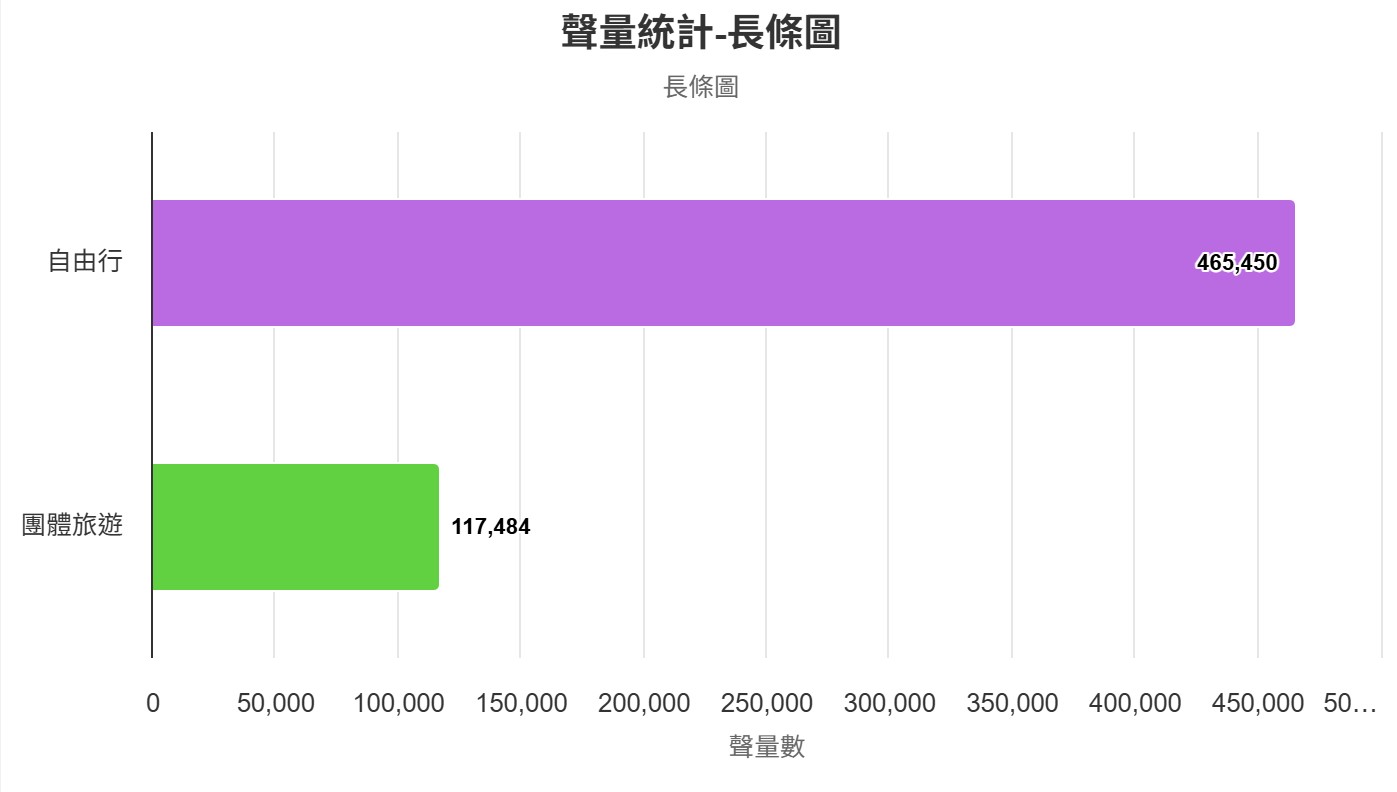

According to OP View’s online volume statistics, independent travel (FIT) generates significantly more online buzz than group tours. Independent travel accumulated a total volume of 465,450 mentions, accounting for 79.8% of the overall travel-related discussions online. In contrast, group tours had only 117,484 mentions, making up 20.2% of the total. This indicates that the majority of online travel discussions currently favor independent travel, suggesting that consumers tend to prefer planning their own itineraries and value flexibility and personalized travel experiences. While group tours still maintain a certain level of attention, their popularity is clearly lower in comparison.
● Insights into Online Buzz Sources

The chart reveals slight differences in the sources of online buzz between independent travel and group tours:
- For independent travel, the majority of online mentions come from social media (87.6%), followed by news (6.0%), blogs (3.0%), and forums (3.4%). One of the most popular posts was a YouTube video about a Fukuoka trip released in December 2024 by YouTuber “見習網美小吳”, which received wide attention. In addition, a Facebook post by “GoTrip旅遊看世界” sharing travel tips for Fukuoka also attracted significant interest.
- For group tours, the buzz is even more heavily concentrated on social media (92.1%), with news (6.5%) accounting for most of the remaining mentions. Blogs (0.1%) and forums (less than 1%) played only a minor role. On Facebook, a public group called “旅遊賠省團” is a key space where users frequently post and discuss various group tour itineraries.
The analysis indicated that while social media is the primary platform for both independent travel and group tours, the buzz around independent travel is more diversified, with a relatively higher share of content from blogs and forums. This suggests that independent travelers are more inclined to share itineraries, write travelogues, or engage in discussion. On the other hand, group tour content is more concentrated, relying more heavily on social platforms for dissemination. These insights offer clear strategic value for brands when tailoring promotional approaches for different types of travel products.
● Positive-to-Negative Sentiment Analysis

According to the sentiment ratio chart, there is a clear difference in online sentiment between independent travel and group tours:
- Independent travel received 133,735 positive mentions, significantly higher than its 33,393 negative mentions, resulting in a positive-to-negative sentiment ratio of 4. This means that for everyone negative comment, there are four positive ones, indicating an overall positive sentiment toward independent travel.
- Group tours received 16,931 positive mentions and only 2,347 negative mentions, yielding a positive-to-negative sentiment ratio of 7.21 –even higher than that od independent travel. This suggests that while group tours generate less online buzz, the proportions of negative feedback is lower, reflecting a more stable and positive overall perception.
In summary, although independent travel dominates in terms of buzz and discussion volume, it also attracts more negative sentiment, likely due to its greater variety and higher degree of autonomy, which can lead to inconsistent experiences. In contrast, group tours, though less discussed, tend to receive more consistently positive feedback, suggesting more stable quality and less controversy in user experiences.
● Gender Distribution and Interest Tags

Independent Travel
- Gender ratio
61% female, 39% male
This suggests that independent travel is more appealing to female audiences, possibly due to their greater interest in planning, exploring, and sharing trip details. - Popular channels and topics
Travel and accommodation , gourmet food, consumer spending, lifestyle sharing, beauty and skincare, video creation, cooking and baking, shopping.
👉 These topics indicate a personalized, lifestyle-oriented preference with a strong female and content-creator focus.
Group Tour
- Gender ratio
54% female, 46% male
The gender distribution is relatively balanced, indicating that group tours appeal a broader general audience, with more male participation and discussion compared to independent travel. - Popular channels and topics
Travel and accommodation, politics and society, news, consumer spending lifestyle sharing, transportation, gourmet food, finance and investment, parenting and education, social welfare.
👉 The scope is broader, covering family life, social issues, finance, and education, making it suitable for various age groups and family-oriented segments.
While independent travel tends to attract a younger, sharing-driven female demographic, with a focus on personalized experiences and lifestyle aesthetics, group tours demonstrate a wider mainstream appeal. They not only include everyday consumption but also extend to news, education, and social welfare, making them ideal for communication strategies targeting seniors, families, and institutional groups.
● Word Cloud Analysis
★ Independent travel –word cloud

● Itinerary / attractions / guides
The keywords “itinerary,” “attraction,” and “guides” are the most prominent in the word cloud, indicating that users are highly focused on trip planning and attraction arrangements. This suggests a preference for customizing travel content rather than following standardized package tours.
● Popular destinations
Many geographic keywords appear, with Japanese cities taking a particularly high share:
- Major cities: Tokyo, Osaka, Kyoto, Sapporo, Fukuoka, Okinawa, etc.
- Other Asian regions: Korea, Seoul, Thailand, Singapore, Hong Kong, etc.
This shows that Japan remains the most popular destination for independent travel.
● Practical keywords:
These include transportation, tickets, accommodation, internet, hotel booking, subway, car rental, download, admission tickets, and self-driving. This indicates that independent travelers have high demand for practical and convenient information, with local transportation planning being an essential part of their trips.
Brands such as Klook, KKday, and Agoda are also frequently mentioned, showing that these platforms play an important role in planning independent travel.
● Content preferences:
Elements such as cuisine, hot springs, cosmetics & pharmaceuticals, and local specialties also appear in the word cloud, suggesting that travelers value local culture and indulgent experiences during independent trips.
Summary:
Independent travelers demonstrate a high level of autonomy, with key focuses on “itinerary planning” and “attraction information,” and tend to use travel platforms for booking and research. The word cloud reveals the overwhelming popularity of Japan –especially major cities like Tokyo, Osaka, and Kyoto, as well as natural scenic areas such as Hokkaido and Okinawa. When planning trips, these travelers seek a wide range of information, from transportation, tickets, and accommodation to food and shopping, reflecting strong tendencies toward information gathering and price comparison.
★ Group tour –word cloud

● Itinerary, travel agencies, travelers, attractions, group tours
Discussions show that netizens focus on the completeness of itinerary planning and the services provided by travel agencies. “Travel agencies" emerge as an important player in these discussions, indicating that most group tour participants rely on professional planning and guided execution.
● Popular destinations:
Frequent keywords include: Korea, Tokyo, Osaka, Okinawa, Seoul, Vietnam, Shanghai, Hokkaido, Kyushu, Thailand, Singapore, and more.
This shows that group tours still focus mainly on short-haul travel to neighboring Asian countries or regions, which offer convenient transportation and fewer language barriers, making them suitable for travelers of all ages.
● Price and services
Keywords such as original price, discounts, spending, air tickets, dates, group tour fees, cruises, etc., show that consumers value price transparency, accommodation quality, and transportation arrangements when choosing group tours. They prefer “all-inclusive” packages with high cost-performance value.
● Demographic needs
Terms like “family-friendly,” “flights,” “pandemic,” “in-depth,” “special,” “charming,” and “themed” suggest that group tour participants often include family travelers with children, senior travelers, or institutional groups. They value safety, comfort, and cultural depth, and tend to prefer itineraries certified or endorsed by government bodies.
Summary:
Online discussions about group tours center on itinerary design, travel agency service, and pricing. Popular destinations are mainly in Asia, appealing to travelers seeking a relaxed, hassle-free, all-in-one travel experience. For brands or travel agencies promoting group tours, the focus should be on “professionalism, safety, and value for money.”
Key Insights:
● Group Tours:
- Keywords focus on standardized itineraries, travel agency services, and popular short-haul destinations.
- Attracts travelers who lack confidence in itinerary planning, transportation, or language skills, or those who prefer convenience (e.g., families, seniors).
- Emphasizes itinerary efficiency, guided services, full-package offerings, and transparent pricing.
● Independent Travel:
- Keywords often relate to flexible planning, local exploration, and personalized experiences.
- Favored by younger travelers, budget-conscious individuals, and solo travelers seeking in-depth trips and off-the-beaten-path spots.
- Relies heavily on digital tools (e.g., travel apps, forums) and community reviews.
Observation Period: July 29, 2024 – July 29, 2025
Sources: Discussion forums, social media, news, blogs
Database and reflects the number of online discussions related to “independent travel and group tours.”

1. A New Chapter in Travel! High-End Luxury Tours on the Rise –“The Farther, the Better” as These Groups Become the Main Consumers
In the post-pandemic era, niche high-end travel itineraries have skyrocketed in popularity –from polar expeditions to in-depth tours of Europe, African safaris, and journeys across Central and South America. Travel operators have discovered that the farther the destination, the better it sells! Tours priced anywhere from over NT$200,000 to NT$1 million are selling out quickly, with some travelers already booking for next year. Industry analysis shows that after three years of the pandemic, high-end travelers are accelerating the fulfillment of their bucket lists, with a strong focus on in-depth travel. This trend has driven a rapid recovery and booming growth in luxury tourism. As for who is joining these multi-hundred-thousand-dollar to million-dollar trips? Travel agencies reveal that the main consumers are retired business owners, tech elites, and wealthy second-generation travelers.
2. NT Dollar Appreciation Plus New National Holiday Policy Reveal Four Major New Travel Trends: More Young People Joining Group Tours
With the global travel market steadily recovering in 2025, the clear appreciation trend of the New Taiwan Dollar, and the implementation of the new “4+1-day” national holiday policy in the second half of the year, the outbound travel market is heating up. According to big data analysis of over 200,000 consumer transactions in the first half of the year, ezfly Travel has released the four major outbound travel trends for the first half of 2025. These include:
- “Japan trips with a self-guided element” gaining popularity among travelers of all ages
- Long-haul group tour participants skewing younger and becoming a favorite for corporate incentive trips
- Customized small-group family tours showing significant growth, among others
3. Record High! Earthquake and Tsunami Rumors Fail to Deter Tourism Surge to Japan –Over 21.5 Million Visitors in the First Half of the Year
On the 16th, the Japan National Tourism Organization (JNTO) announced that despite a sharp decline in visitors from Hong Kong due to earthquake rumors, Japan still welcomed 21.5 million tourists in the first half of this year –a record high and a 21% increase compared to the same period last year. According to the latest figures from Taiwan’s Tourism Administration, 2.14 million Taiwanese traveled to Japan from January to April this year, and the annual total is expected to surpass last year’s 6.04 million.
JNTO statistics show that in 2024 alone, Japan earned an impressive 8.1395 trillion yen (approximately NT$1.6178 trillion) from tourism, and this year is set to break last year’s record.
According to AFP, the tourism board stated in a press release: “Surpassing 20 million inbound visitors in the first half of the year marks the fastest growth rate on record.”
4. AI Adoption in Global Tourism –Experts: Travel Planning Shifting Toward Experience-Driven
International travel booking platform Booking.com has released its “Global AI Perception Report,” indicating that AI is becoming an indispensable part of the travel experience. Experts note that people are now using AI tools to ask questions like, “If I want to see a concert this year, where is Taylor Swift performing?” –signaling a new trend of searching based on experiences.
The report shows that 91% of respondents worldwide are excited about AI, and 79% say they are familiar with the technology, though awareness levels vary by region and many still have concerns about its potential impact. However, 89% of consumers expressed a desire to use AI in future travel planning, with AI assistants viewed as a more trusted source of information than travel bloggers or social media influencers.
5. First in Asia! China Airlines to Launch Direct Flights to Phoenix on December 3 with Three Weekly Services –STARLUX to Follow in January
China Airlines has announced the launch of a new route to Phoenix on December 3, making it the seventh North American passenger destination in its network. Operated by the Airbus A350-900, the service will offer three round-trip flights per week. The airline sees strong potential in Phoenix as an emerging tech hub in the southwestern United States, with growing demand from business travelers, making it the first Asian carrier to operate flights to the city. STARLUX Airlines will also begin direct flights to Phoenix on January 15 next year, likewise offering three weekly services.
6. 2025 World’s Cleanest Airlines Ranking Announced –This Taiwanese Carrier Takes the Top Spot
In 2025, international airline rating agency Skytrax officially released its World’s Cleanest Airlines ranking, based on passenger surveys conducted from September 2024 to May 2025 across 325 airlines worldwide. The evaluation covered cabin seat cleanliness, tray tables, carpets, interior panels, and lavatories. The biggest highlight of this year’s list: Taiwan’s EVA Air claimed the number one spot in the world!
※CheeseAd is an advertising agency specializing in serving clients in the tourism industry. To better understand the current state of tourism in Taiwan for our foreign clients, we have selected news or information from your platform. If you have any comments regarding the above excerpts, please feel free to contact us. Thank you!

● AI Reshapes Google’s Ad Exposure Strategy –How Can Advertisers Seize New Opportunities to Stand Out?
With Google deeply integrating generative AI into its search products, the advertising industry is undergoing an unprecedented structural shift. In this wave of change, how should advertisers reposition themselves from the traditional keyword advertising model? What will future exposure formats and trends look like?

Google Ads Become Part of the AI Answer
Through AI Overviews and AI Mode, Google has embedded search and shopping ads directly into AI-generated responses. In short, the biggest change in ad display under this AI wave is the shift from traditional blue links to AI content integration. For example, when a user searches “how to fly with a dog,” ads for “dog travel carriers” may appear right below the AI’s answer. Ads are no longer confined to small boxes at the top of the page –they’re now embedded within the AI-generated response section at the top of the results page.
This “content-as-advertising” approach is seen as a new opportunity to boost conversion rates. Brendon Kraham, Google’s VP of Search Ads, said: “We’ve faced similar shifts before and adapted successfully, so we’re confident in the commercialization of this AI experience.” Jim Yu, founder of SEO platform BrightEdge, noted that traditional search simply lists results for users to research themselves, whereas AI-driven search summarizes and draws conclusions –for example, listing pros and cons –guiding users more directly toward purchases, which is a major departure from the past.
Generative AI Helps Advertisements Blend Into Content
In facing this new ad exposure model, advertisers must focus on a few key points. First, ad placement needs to “seamlessly” integrate with content. Since ads now appear within AI-generated answer paragraphs, it is more important than ever to ensure a high level of relevance between the content and the product, making the exposure feel more natural. Matt Steiner, Head of Biddable Media at agency Croud, put it bluntly: “If people change their search habits and increasingly use AI to look up commercial information, shifting ads into these scenarios will be inevitable.”
Source: Business Next
https://fc.bnext.com.tw/articles/view/3973
● Google AI Summaries Siphon Media Traffic –Taboola Launches “DeeperDive” AI Q&A Engine to Help News Outlets Regain Control
As Google officially integrates AI Overviews into its search results pages, more and more users are stopping at the AI-generated summary when searching, leading to a sharp decline in click-through rates and ad traffic for original news sites. This has dealt a serious blow to media outlets that rely heavily on traffic-driven revenue. In response to this generative AI revolution led by Big Tech, third-party online advertising platforms are starting to roll out countermeasures.
Global content recommendation leader Taboola has introduced a new product, DeeperDive, a generative AI Q&A engine designed specifically for news media websites. The platform emphasizes embedding publishers’ original content within their own traffic ecosystem, preventing large search platforms from extracting its value, and reestablishing a direct relationship between news outlets and their readers.
Three Core Values: Smart answers, eeeper engagement, and ad monetization
According to Taboola, DeeperDive will bring three key benefits to media websites:
1、Provide real-time, contextualized content answers
2、Increase reader loyalty and interactive engagement
3、Create a new generation of high-conversion ad models
Source: Tech Bang
https://www.techbang.com/posts/123740-taboola-deeperdive-ai-news-control
● Meta Officially Introduces Advertising on WhatsApp
For the first time, WhatsApp is showing ads to users –though currently only within its Status feature. Status is one of WhatsApp’s key sections, used to share real-time updates from friends and family in the form of text, photos, videos, and GIFs, which disappear after 24 hours. According to WhatsApp, the Status feature has as many as 1.5 billion daily users.
The new policy includes allowing users to pay a monthly subscription to receive exclusive Status updates from specific channels; promoting channels within the Status view to increase their visibility; and enabling businesses to promote products within Status.

Source: iThome
https://www.ithome.com.tw/news/169581

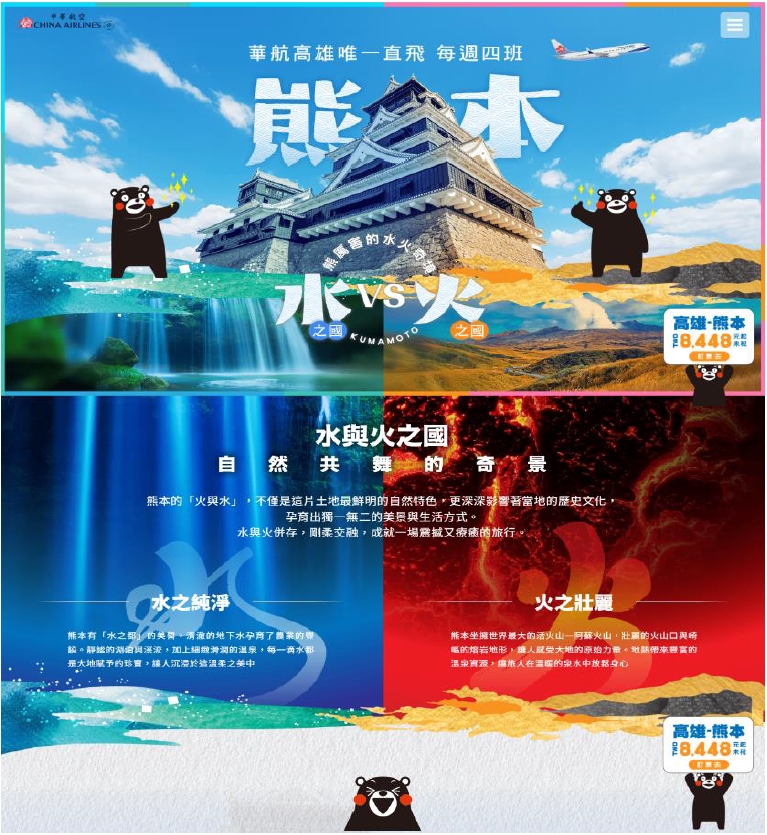
Kumamoto’s “fire and water” are not only its most striking natural features, but they have also deeply influenced the region’s history and culture, shaping unique landscapes and lifestyles. Here, fire and water coexist –a fusion of strength and softness.
The Splendor of Fire
Kumamoto is home to the world’s largest active volcano –Mount Aso. Its magnificent crater and rugged lava terrain let visitors feel the raw power of the earth. Geothermal energy also brings abundant hot spring resources, offering travelers the chance to relax body and mind in soothing mineral waters.
The Purity of Water
Known as the “City of Water,” Kumamoto’s clear underground springs nourish its fertile farmlands. Tranquil lakes and streams, along with silky-smooth hot springs, make every drop of water a precious gift from the earth –inviting visitors to immerse themselves in gentle beauty.
Concept Idea:
Highlight Kumamoto’s uniqueness by presenting the “Water Country” and “Fire Country” experiences side by side for consumers.
The webpage will be split 50/50, listing attractions for both the Water Country and the Fire Country, creating a visually striking contrast.
The goal is to evoke the atmosphere of Kumamoto’s fire and water and inspire travelers to book flights to visit.
“Fire Country vs. Water Country –All the Fun in One Place”
Campaign Page:
Showcase Water Country vs. Fire Country experiences
https://event-2.7to.com.tw/landingpage/25ci_kumamoto_kh/

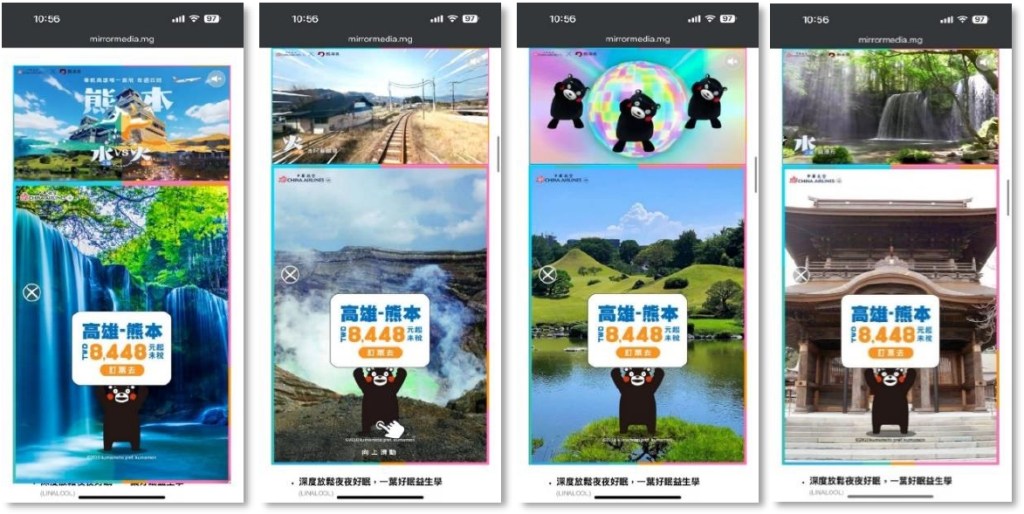
Special Ad Placement:
Feature the Water Country vs. Fire Country theme
Kaohsiung Light Rail Charter Creative Execution:
Direct Flights from Kaohsiung to Kumamoto, Kumamon × Kaohsiung Bear


Kaohsiung Light Rail Charter Creative Execution:
First-ever 1:1 installation of the Kaohsiung Bear for interactive experiences with the public

Kaohsiung Light Rail Charter Creative Execution:
First-ever 1:1 installation of the Kaohsiung Bear for interactive experiences with the public

Kaohsiung Light Rail Charter Creative Execution:
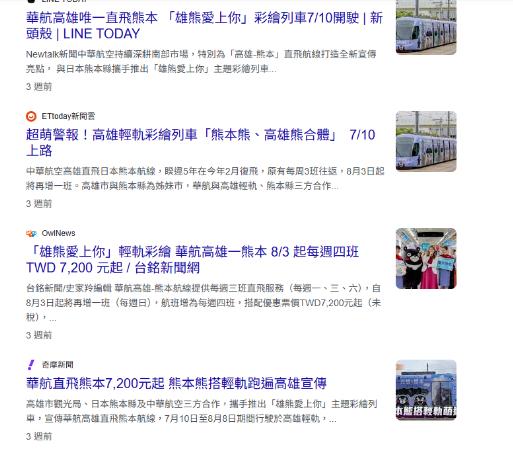
Creative presentation generates media buzz, drawing widespread coverage and sparking public discussion
 啟示整合行銷